Tuesday, April 13, 2010

Monday Beads

I've always been interested in how quickly knowledge disappears, how soon we forget what really happened and how stories repeated become remembered truth. This is particularly common in families, I think, where everyone remembers the time Jimmy wanted to fly and jumped off the garage roof, or the time Cathy took her dress off during Christmas dinner. Well, everyone thinks they remember, but often the memory has been implanted by hearing the story over and over again until it becomes a visual recollection.
 
I don't remember much from my childhood. I look at the photographs and see my sister Nancy and me dressed in shorts sets on our annual Highlights-of-the-East summer car trips to Niagara Falls, Williamsburg, the Jersey shore, Washington, DC, the Skyline Drive or Cypress Gardens. I don't really remember those trips, though I do have a vague memory of throwing up on my sister's needle work somewhere in the mountains.
There are other "memories" I have that aren't visual but are still firmly embedded in my brain. I remember our mother telling me that Nancy got her head stuck between the spindles in the second floor railing and they had to call the fire department to get her out. To be clear, I don't recall the event but I recall the telling of it. My sister doesn't remember it. So did it happen or not?

Mom also told me that Nancy once stuck a bean up her nose. I have a clear picture in my mind of Nancy crying with a green bean up her nose, although sometimes it's a lima. I wasn't there and I guess I never asked Mom what kind of bean it was so the image, though perfectly clear, alters slightly depending on the day.

As it happens, Nancy is visiting us in Pittsburgh this week and I was excited that she'd be here for Monday Beans and I thought maybe she'd reprise the bean-up-the-nose trick.

But when I mentioned this to her she said, "Bead."

"Bead?"

"Bead."

"What kind of bead?"

"I think it was a wooden bead, the kind you string. I don't really remember."

What?! She doesn't remember either? Did it even happen? I'm shattered. I have this clear picture of Nancy with a bean up her nose and I was going to cleverly tie that into Monday Beans and now I learn it's a bead and we don't even know for sure what kind of bead. The image in my mind is wrong and it makes me wonder what other memories and stories are suspect. With no actual memories of my own, I now have a childhood that's a vast empty tundra. And beanless.

Pigeon Peas and Rice

2 cups pigeon peas, soaked overnight
1 onion, chopped
1 bay leaf

Saute the chopped onion in a little olive oil until transparent. Add the pigeon peas and bay leaf and water to cover by an inch or two. Bring to a boil then lower the heat and cook until the pigeon peas are just tender.

1 onion, chopped
2 cloves garlic, minced
1 red pepper, chopped
1/2 tsp turmeric
1/2 tsp paprika
1 tsp ground cumin
1/2 cup sofrito (I used frozen, feel free to make your own)
1-1/2 cups rice
3 cups vegetable broth
liquid smoke
balsamic vinegar
Vegetarian worcestershire sauce
Salt and pepper
Cilantro

Saute onion, garlic and pepper in a little olive oil until transparent. Stir in the spices and saute a few more minutes. Add sofrito and cook a few more minutes. Add the rice, stir until coated, then add the broth, bring to a boil then reduce heat and simmer until rice is almost cooked. Add the drained pigeon peas, stir to combine. Add a little liquid smoke, some worcestershire and balsamic vinegar. Add salt and pepper to taste and garnish with chopped cilantro.


These were ok, not great. And Nancy wouldn't put any up her nose.

Monday, April 5, 2010

Too Much Dal

I'm deep into spring cleaning. Serious spring cleaning, where you not only throw open the windows and scrub and mop and clean windows, but where you dig deep in the back of closets, open the boxes piled in the attic and basement and sort through the junk drawers and catchall bins. And much to Jack's consternation, the agenda includes adding a fresh coat of paint on ceilings, walls and woodwork as we move from room to room. You'd think I'd've done this before hosting my family last summer for our son and daughter-in-law's wedding but better late than never.

I haven't tackled the basement pantry shelves yet. That's Jack's domain because he's the one who gets sent down for a box of pasta or a can of tomatoes or a steamer pot, so he organizes it his own way. This morning, though, as I was passing through, I noticed a large Tupperware tub of ingredients for Indian food. The colors caught my eye and I brought the container up to the kitchen to inventory. In addition to curry powder, garam masala, and a collection of other spices, there were four kinds of dal: chana, masoor, split urad with skins and moong. I've made various kinds of soupy dal using all of them, but it's spring and warm out and isn't there something else I can make with them besides a spicy hot dish?

Turns out there is. I've got a hefty tome by Yamuna Devi called The Art of Vegetarian Indian Cooking, the subcontinent version of Julia Child's opus. On page 573 (of 800 pages) there's something called Dal Munchies or Moong Dalmot. It looked like a perfect change of pace.

Fried Dal

Sort through 1 cup of moong dal and wash in several changes of water until it is clear. Drain, then soak in 4 cups of water and 1 tsp. baking soda for 8 hours or overnight. Rinse, then drain, then pat dry with paper towels and air-dry for 30 minutes.

Heat oil in wok or deep fryer until moderately hot (365 degrees.) Fry 1/4-1/2 cup of dal at a time in a wire mesh strainer just until it floats to the surface. It cooks really fast, so don't overdo it. Drain on paper towels and season with plain salt or any kind of seasoned salt. I used a salt with coriander in it, although you couldn't really taste it. I might try smoked salt next time.
 This is a super-crunchy snack, and you can make it as salty or not as you like. I'm a sucker for salty snacks and with this I can delude myself that it's good for me because it's protein! It was a big hit with drinks before dinner.Be forewarned, though: don't make it if your teeth aren't firmly attached.

Thursday, April 1, 2010

Old Beans and Ancient Grains

Ever since I began Monday Beans I've been on the lookout for different and interesting varieties. I'm a member of the East End Food Co-op but they only have the usual kinds. I found the best local selection at Penn Mac, just about my favorite food emporium in Pittsburgh.
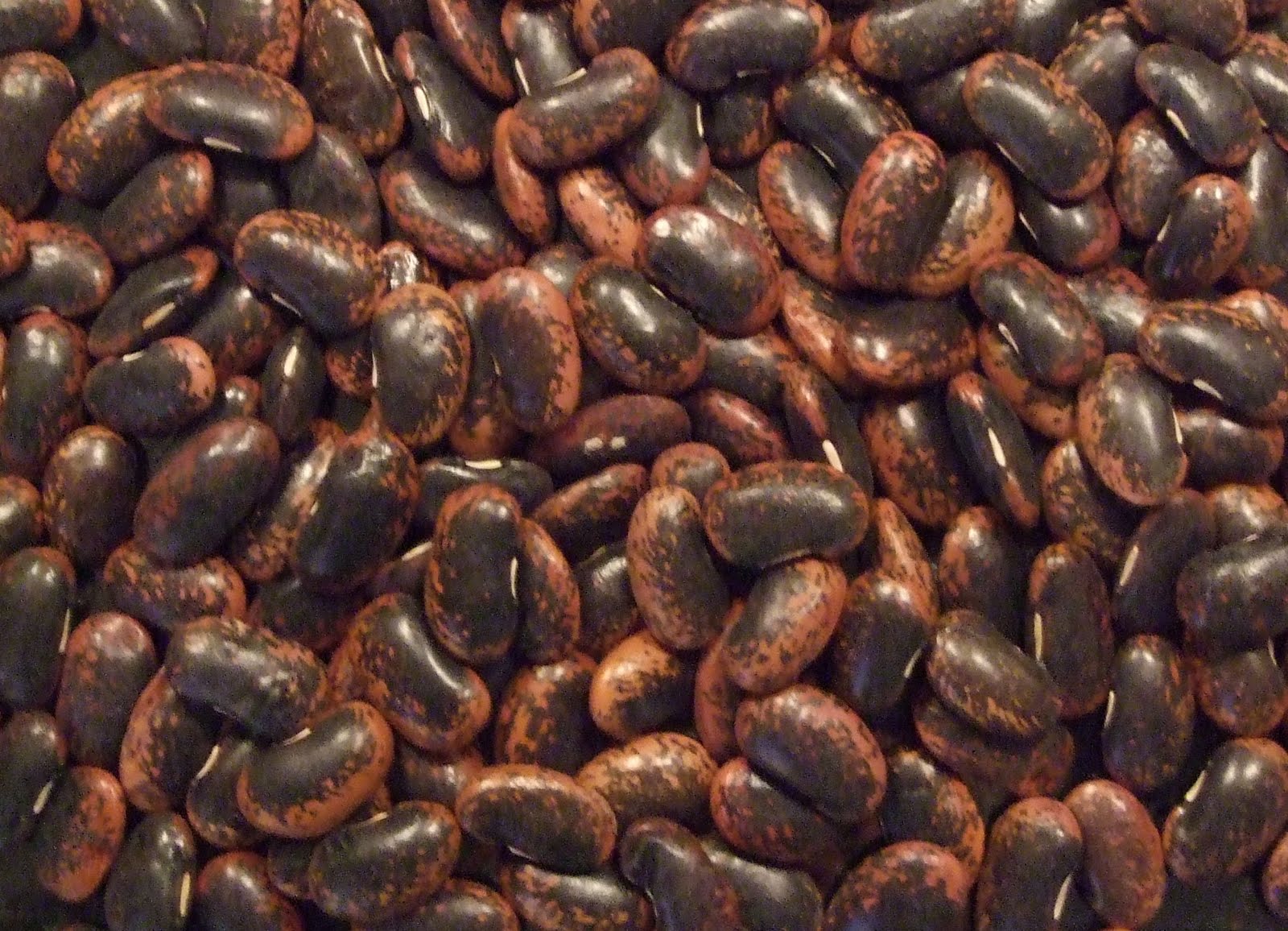
Purely on looks alone I picked up some Scarlet Runner Beans, then had to look them up. Turns out they're an heirloom variety, known at least as far back as the eighteenth century and grown in Thomas Jefferson's garden. The vines produce beautiful red blossoms that attract hummingbirds so they're a favorite with backyard gardeners.

These are big beans. I figured they'd be better as a accent ingredient rather than the main thing. A little more poking around and I came across Lorna Sass's Scarlet Runner Beans with Farro Risotto from the book Heirloom Beans by Vanessa Barrington and Steve Sando. (I'm amazed at how many great food blogs there are!) Lorna Sass is queen of the pressure cooker and that brings up an interesting point.
I've been using a pressure cooker for beans since I inherited an old 1940s Presto 6-quart back in the 70s. For Monday Beans, though, I've been cooking the beans the old-fashioned way, soaking overnight and cooking in a saucepan. I just want to get to know the beans a little better and some beans go mushy too quickly in a pressure cooker. So I used Lorna Sass's ingredients as a guide, but I made the risotto the usual way.

I actually had farro in the house and was glad to find an interesting use for it. Farro is an ancient form of wheat and originated around the Mediterranean and Middle East.

Old Bean and Ancient Grain Risotto

2/3 cup scarlet runner beans, soaked overnight
1 small onion, chopped
1 bay leaf
1/2 tsp. saffron
2 Tbsp. boiling water
1 onion, chopped
1/2 cup white wine
1 cup farro
4 cups vegetable broth
1/2 cup toasted walnuts, chopped
1 tsp thyme
1/2 cup grated romano cheese
salt and pepper to taste

Saute the small chopped onion in a little olive oil until transparent. Add the beans and soaking water, bring to a boil, add the bay leaf and reduce heat to simmer. Cook until the beans are tender. This took forever for me. Halfway through I almost reconsidered the whole pressure cooker thing. In the end it took nearly three hours to get the beans to the edible stage. I did this the day before.

To make the risotto, heat the broth to simmering and keep it hot. In a small bowl dissolve the saffron in 2 tablespoons of boiling water. In another saucepan saute the onion in a little olive oil until transparent. Add the farro and stir to combine. Add the saffron water and cook for a minute until fragrant. Add the wine and stir until nearly dry.

Add 1 cup of hot broth and stir until absorbed. Keep adding broth and stirring until all of the broth is incorporated. Add the drained beans and cook for a few more minutes. Stir in the thyme, walnuts and cheese, and salt and pepper to taste.

 My sister-in-law was in town on Monday and we both thought this twist on risotto was great, and the beans themselves were delicious. I think next time I'd add some red pepper flakes and a squeeze of fresh lemon juice to brighten the flavor.

Tuesday, March 23, 2010

New cousins, new beans

I'm a family history addict. I'm lucky to have been born into a family of story tellers and writers, so reading and listening to family lore my whole life made me want to know more about the various branches of my ancestry.

Genealogy is a multidisciplinary journey. First I learned about public records and archival research; then record-keeping and sourcing. When my search for ancestors moved offshore I dredged up my high school French and German and acquired some basic Latin. As the family tree grew I wanted to know why people left their homelands. What was their life like? Why did their names change? So I sought out histories of the Huguenots, Quebec, the Banat, Haiti, Puerto Rico and St. Thomas to learn about their lives.

Sometimes I get lucky and uncover old photographs, but more often than not they're unlabeled and undated. So I study the clothing, the studio, the style of the image, the framing, the paper they're printed on, the faces of the subjects, anything that can help estimate the date and place or identify the people.

Every new type of document, record or artifact requires a knowledge base in order to evaluate its authenticity and understand its significance.

When I first started more than twenty years ago family history research required spending hours and hours in dusty libraries scanning rolls of microfilm until I was nearly seasick from the jumping, weaving images. I paged through delicate church registries in white archive gloves hoping to inch back another generation. I used library phone books to find possible distant cousins in other regions and wrote hundreds of letters that began, "You don't know me but I believe we are related...."

Suddenly--and it does seem sudden--we find ourselves in the future. Millions of records have been digitized and indexed. Phone directories are online. People share their research on family history websites hoping to collaborate with others researching the same lines. And best of all, social networking has been embraced even by the AARP set.

I like to identify an immigrant ancestor then find every one of his or her descendants all the way to the present day. I've done this with two lines so far, and I'm onto a third, a 4th great-grandfather named Archibald Liggett who made the journey from the British Isles to St. Thomas sometime around 1800. Archibald had five children. Two sons and a daughter stayed in St. Thomas; one son went to Philadelphia (my line) and one went to Louisiana. I'm determined to fill in this whole family tree.

I've recently discovered that one branch of the Liggetts of St. Thomas  migrated to Costa Rica, and what's more, I've connected with a new-found cousin in San Jose. I love meeting new cousins, not just because I gain new family information but because connecting with another descendant of a immigrant ancestor reminds me that a long time ago one person changed the course of generations by leaving his homeland to build a better life for his family. 

In the course of learning more about Costa Rica, I discovered their version of beans and rice, gallo pinto. I poked around the internet for a definitive recipe then smacked my forehead and thought, wait a minute -- I have the inside track! I asked my new cousin for a recipe and he was happy to oblige. I've edited a little for clarity.

My beloved cousin Marce,
Responding to your request about one of our typical dishes Gallo Pinto, I asked my wife who really knows how to cook, well she teaches in a cooking academy Cocinart here, cause I do not cook is not one of my strongest points, but in the other I love to eat very well, probably cause I got used to it cause my grandmother Myra May and my mother Andrina were great cooks.
Before we go into it let me explain certain facts
  • Rice is one of the most basic ingredients in Costa Rican diet
  • Beans the same, you could find them Black, Red, White, baby beans, Cubaces that are a bit bigger and so on, we eat them in different ways and at any hour.
  • Gallo Pinto is called like that because the mixture resembles the spots of a rooster.
  • We eat it at breakfast, most usually with fried or scrambled eggs on top and with a tender or fresh cheese also with bacon or ham or chorizo, also with something sweet as French toast or fruits as melon, strawberries and of course with coffee, it is like a small brunch.
Well here is what I’ve got for you

For preparing it, you should have already prepared rice or cooked , better from a day before.

Rice:

2 spoons of vegetable oil
2 spoon of copped onions
3 cups of normal white rice (washed and drained out )
Boiling water
Salt at taste
¼ of a red pepper cut in slices (optional)
To be cooked in a microwave oven. In a big pan, (usually they sell the ones for cooking rice) you put the rice the salt and the vegetable oil , the onion, boiling water to cover the rice surpassing it 1 cm. or so (1/2”) set the heat to hi till it drays, take it out and  stir with a fork one or two times. Lower the heat, add ½ a cup of boiling water, the red pepper and cook at low heat for 10 minutes, and should be ready. Take it out and stir again with a fork till is loose.

Beans:

In Costa Rica when you are going to cook beans we say “ Voy a poner frijoles” or  I’m going to put beans,  not cook. Over here you can get them at the supermarket in a 1 kilo (2.6 pounds) packages.

You wash them well and leave them in water for at least one hour. You can cook them in a slow cooker or better in a pressure cooker so you’ll finish sooner. You put them in the pan then you add 1 garlic, 1 celery straw, thyme and oregano, and if you like it coriander and sufficient water salt to the taste. After the sound of the valve you leave them cooking for 30 to 35 minutes more at low heat. You then let it cool, so you can open it, then the salt is verified to taste,  and the tenderness of the beans.
In a fry pan with two spoons of vegetable oil, 2 spoons of chopped onion, chicken broth to the taste, till the onion is transparent, then you add it to the cooked beans. The first day we have what we call sopa negra if the beans are black or just bean soup if they are of other color, with cooked eggs, and avocado on it also with rice .

Gallo Pinto
Having already cooked rice and beans from the day before, in a big fry pan, cook 2 or 3 spoons of vegetable oil, 2 or 3 spoons of chopped onion till   the onion is transparent.

Add 3 cups of cooked rice and 1 and a half cups of the baked beans from yesterday, stir and blend, add 1 spoon of Lea & Perrins sauce; we use Salsa Lizano .
(From Marce: I was not familiar with Salsa Lizano, so I went to our favorite Latin American/Caribbean grocery to get it. Apparently it's very popular; there was lots on the shelf.)
Then the onion is added then chopped red pepper and coriander. Blend and serve. If you like hot sauce you add it or leave it to the people to make the choice.

Enjoy.
These beans were incredible. I followed the recipe exactly except I cooked the rice in a pan instead of the microwave, and of course I didn't use chicken broth. We ate them with a Field Roast Chipotle Sausage and a couple of leftover sweet potato tamales in banana leaves. Delish! Thanks, cuz.

Tuesday, March 16, 2010

St. Patrick's Day, Police and Boston Baked Beans

I love audiobooks and I find them particularly wonderful when I can't sleep. I can lie quietly with my earbuds and listen to a great novel or history or travel adventure and the insomnia time is never wasted. Sometimes, though, my brain wants something I don't have to focus on, something to just drone in the background while I swim from thought to thought to thought. Music doesn't do this for me because music demands my attention. I've never been one to have music in the background; if it's on, I must listen fully engaged, which makes it difficult to focus on conversations when there's "dinner music" playing.

Anyway, I recently found the perfect background generator for me: a police scanner. Laugh if you will, it's been enlightening. Poking around the iphone app store I found "5-0 Radio" which has scanner feeds from all over the US and the World. I started listening to it last Saturday night, the night of the annual St. Patrick's Day parade. It took awhile to figure out the protocols and get into the rhythms of the exchanges between the dispatchers and the cops, but eventually it could percolate just beyond my consciousness until a particular exchange piqued my interest.

Saturday night there were mostly "male intox" or "female intox" refusing to leave bars or stumbling down the streets making noise or mischief. Later there were "male-female domestics" as the drunks got home and started abusing the family. All the while I was impressed with the calm demeanor of both the dispatchers and the police, and especially with their strict adherence to protocol.

I grew up in a tiny little suburb of Philadelphia where we had maybe four policemen and they mostly parked by the lake and read the paper. During the hippie years they became a little edgy and tended to over-react at the slightest infraction, even once actually shooting at a kid who was caught with a joint and climbed a tree to get away from them. Luckily they didn't kill him, but suburban cops do tend to freak out whenever something interrupts their coffee and donuts. Yes, it's a cliche but it's true.

About ten years ago I was on a criminal jury in an insurance fraud case. The owner of a motel and restaurant had hired a man to run the restaurant. One morning the owner arrived and found that all of the big restaurant equipment was gone. He asked the manager what happened and was told it must have been stolen. The police and insurance company were called. In the investigation it was discovered that the manager sold the equipment to a broker and pocketed the money. When he got caught he told the police that it was a scheme cooked up by the owner. Turned out the manager had a criminal record of theft and fraud, yet he was -- except for the police -- the only witness against the owner who happened to be Jain, an adherent of one of the world's most peaceful religions. There was no evidence against the defendant.

The trial lasted a few days and when we finally received our instructions and went to the jury room, we immediately called for a vote. It appeared just from looking at each other that we might have a quick not-guilty vote and get out of there. One member of the jury objected to the quick vote, saying that she was convinced that the owner was guilty. When we asked what made her think that, she said she was the daughter and sister of police officers, and that police wouldn't have arrested the defendant if he weren't guilty. For the next two days eleven people tried to convince this one girl that there was no evidence against the defendant and that the police picked the wrong guy to try to convict. Eventually we prevailed, but the experience left a bad taste in my mouth for Pittsburgh police.

Things have died down from the St. Patrick's Day festivities and last night as I lay awake trying to adjust to daylight savings I tuned in again to the Pittsburgh public safety channel. It was a quiet night, a few burglar alarms. A break-in. An attempted suicide. A couple of neighborhood parking disputes. All conducted in the calm, reasonable tones that I'm finding restful and reassuring.

So I say hats off to our public safety workers, the police, the EMTs, the fire fighters. They may not be perfect, sometimes they're over-zealous, but it's comforting to know they're out there, watching over us, keeping us safe. And though they're not mostly Irish any more, in their honor we're having Boston Baked Beans and Boston Brown Bread.


Boston Baked Beans

1 lb. navy beans, soaked in water to cover for 8 hours or overnight
3 T. olive oil
1 large sweet onion, quartered and sliced
3 cloves garlic, minced
1/3 cup dark molasses
1/3 cup brown sugar
1 T. dry mustard
1/4 tsp. cayenne
2 tsp. tamari
1 tsp. liquid smoke
1 bay leaves
1 tesp. salt
freshly cracked pepper

Cook the beans until barely tender. Drain and save the cooking water.

Caramelize the onion in the olive oil. Add the rest of the ingredients and some of the bean water. Add the beans, stir to combine then put in an oiled bean pot or casserole with enough of the bean water to just come up to the level of the beans. Bake in a slow oven (300 F) for 5 or 6 hours, adding liquid as necessary so the beans don't dry out.

Jack added some cooked ham to his beans. You could also add bacon or ham while the beans are cooking, but they're very tasty just as they are. 

Boston Brown Bread

1 cup whole wheat flour
1 cup rye flour
1 cup cornmeal
2 tsp. baking soda
1 tsp. salt
2/3 cup dark molasses
2 cups milk
2/3 cup dried currants

Tuesday, March 9, 2010

PLOs

We ate and drank way too much last week, a result of a couple of special dinners with family and friends. Too much wine and champagne, pasta and cheese, cookies and ice cream, and there are lots of small amounts of ingredients left in the fridge. So it's PLO night. PLO stands for Pieces Left Over and was my mom's name for a scrounged meal like what we had for our Monday Beans dinner.

Here's what I managed to assemble: half a package of sliced baby bella mushrooms, 1/2 carton of Pacific brand French onion soup, 2 stem tomatoes, 1/2 red onion, some fresh chives and 3 green onions. On the bean shelf I had 3/4 cup of French green lentils and a new package of quinoa, which I've never eaten or cooked before.
 
Cook the lentils in onion soup to cover until just tender, about 15 minutes. Drain, saving liquid. In the same pot, put 3/4 cup quinoa and 1-1/2 cup onion soup, or if there isn't enough, add water to make 1-1/2 cup. Cook the quinoa like rice: bring it to a boil then reduce heat and simmer until liquid is absorbed, about 20 minutes.

Meawhile saute the chopped onion and mushrooms in a little olive oil. Add chopped tomatoes and chopped chives. When the quinoa is ready, add it along with the lentils to the onion-mushroom mixture. Stir to combine, season to taste with salt and black pepper. Garnish with green onions. Mmmmmm. Tasty and healthy. My guilt is gone.

Monday, March 1, 2010

Red Beans and Lillian

My mother Lillian died two years ago today. She was almost 97 and had all her marbles so I can't really complain; I had a lot more time with my mother than most people get. Nonetheless I miss her every day.

Lillian was a gentle pioneer. She wasn't a nuclear physicist or an inventor or a modern dancer. She didn't march for civil rights or burn her bra. But she changed her own world with a quiet determination and in the process helped create the world my sister and I inherited.

Lillian was born in 1911, one of six children, and despite the fact that no woman in her family had ever gone to college, she decided that was the path for her. She worked her way through West Chester State Teachers College first as a waitress in a tea room, then later as the equivalent of an au pair with a local family. My sister is named for the baby she helped care for between classes and studying. 

At the beginning of her last semester her father died suddenly at the age of 56, leaving her mother with three children still in school. Lillian and her older sibs pitched in and helped support the family but she was not about to give up her dream. She arranged to do her student teaching near home and worked at Wanamaker's department store after graduation until she found a teaching job. 

It was the policy of many school districts in America at the time that only single women were allowed in the classroom. Women were required to resign if they got married and often had to agree in writing before their contract was approved by the school board. According to a 1932 National Education Association survey, married women teachers were discriminated against because they were thought to be inefficient and distracted by family needs and likely to miss school time, or that they would neglect their own families and do long-term damage to the next generation. Mostly they were discriminated against because married women were presumably supported by their husbands, and if they worked they were taking jobs away from men or single women who needed the income more.  
 
Shortly before she died, my mom told me that in 1938 she went into her principal's office and annouced that she was getting married in June. And what's more, she said, "I'm not quitting my job."

"What did he say?" I asked. 

"Well, he was mad," she said. "But he couldn't do anything about it. Things had changed."

Things had changed. Discrimination against married women in the classroom had been challenged in court in several states, and though the practice continued for decades in many areas, Lillian offered her own quiet challenge and kept on teaching. 

I never knew that. She never told us. What she did, though, was set a subtle example of equality for women long before the feminist movement. We were nearly the only kids in school whose mother worked and I was proud of her, happy that she had her own life, that she didn't dote on us like present-day helicopter parents, that she had interesting things to tell us about her day when we traded tales around the dinner table. She had a sense of self-worth beyond being a wife and mother, and that image was absent in TV shows and movies in the 50s. 

I asked her once what it was like to be a working woman in the era of perfect homemakers like Donna Reed and Harriet Nelson. She shrugged and said she never thought about it. She never knew what a pioneer she was and what an inspiration she was to my sister and me. 

But what about beans?!?

Mom told me once her mother used to make red beans. I never asked her what they were like, and she never made them for us that I can remember. So in honor of my mother, we're having plain old red beans and rice tonight. This is just a guess, but I sure wish I could call and ask her how to make them. 

Red Beans for Lillian

1/2 lb. kidney beans, soaked overnight in water to cover
2 T. olive oil
1 medium onion, chopped
1 celery stalk, chopped
1/2 green pepper, chopped
1 clove garlic, minced
2 cups vegetable broth
1/2 t. smoked paprika
1/4 cup chopped fresh parsley
salt and pepper to taste 

Drain beans. Saute the onion, celery, pepper and garlic until just beginning to brown. Add the beans and broth, bring to a boil then lower heat and simmer until beans are just tender. Add paprika and parsley. Season with salt and pepper to taste. Punch it up with the hot sauce of your choice and serve on rice.  For as simple as these beans are to make, they're really delicious.